

Nightly docs
Book Imbalance Backtest (Betfair)
This is a Rust-only system tutorial. It drives the Rust BacktestEngine
directly with raw Betfair streaming data, bypassing the Python and Parquet paths.
This tutorial backtests a BookImbalanceActor on a Betfair MATCH_ODDS market.
It loads a raw historical streaming .gz file, feeds it through the Rust
BacktestEngine, and tracks the bid/ask quoted-volume imbalance per runner.
Introduction
Betfair is a sports betting exchange where participants back (bid) and lay (ask) outcomes at decimal odds. Each runner has its own L2 order book that behaves like a financial order book.
The actor reads OrderBookDeltas for every runner and accumulates two
running totals per side: bid volume (back orders) and ask volume (lay
orders). Per-batch and cumulative imbalance are computed as:
imbalance = (bid_volume - ask_volume) / (bid_volume + ask_volume)A positive value means the market is leaning toward backing the outcome. Sports traders use this as a starting block, often combined with price momentum or market-wide features.
A release build processes about three million data points per second with full order book maintenance in the matching engine.
Prerequisites
- A working Rust toolchain (rustup.rs).
- The NautilusTrader repository cloned and building.
- A Betfair historical
.gzfile containing MCM (Market Change Message) data. Source it from Betfair historic data, a third-party archive, or by recording the Exchange Streaming API yourself.
Place the file at:
test_data/local/betfair/1.253378068.gzThe example's DATA_FILE constant points at this gitignored path. The
results below come from a self-recorded football MATCH_ODDS market with 3
runners and around 82,000 MCM lines recorded over 18 days. That file is not
distributed with the repository. To run without it, pass a sample that ships
in test_data/betfair/, such as test_data/betfair/1-166811431.bz2; the
loader also reads .bz2 files.
Loading the data
BetfairDataLoader reads gzip-compressed Betfair Exchange Streaming API
files and parses each line into Nautilus domain objects:
use nautilus_betfair::loader::{BetfairDataItem, BetfairDataLoader};
use nautilus_model::types::Currency;

let mut loader = BetfairDataLoader::new(Currency::GBP(), None);
let items = loader.load(&filepath)?;
The loader returns a Vec<BetfairDataItem>:
| Variant | Description | Maps to Data enum? |
|---|---|---|
Instrument | Runner definition from market definition. | No (added separately) |
Status | Market status transition (PreOpen, Trading...). | Yes, Data::InstrumentStatus |
Deltas | Order book snapshot or delta update. | Yes, Data::BookDeltas |
Trade | Incremental trade tick from cumulative volumes. | Yes, Data::Trade |
Ticker | Last traded price, volume, BSP near/far. | - |
StartingPrice | Betfair Starting Price for a runner. | - |
BspBookDelta | BSP-specific book delta. | - |
InstrumentClose | Settlement event. | Yes, Data::InstrumentClose |
SequenceCompleted | Batch completion marker. | - |
RaceRunnerData | GPS tracking data (horse/greyhound racing). | - |
RaceProgress | Race-level progress data. | - |
CricketMatch | Cricket match data (from CCM). | - |
The backtest engine accepts the Data enum, so we map the variants we need
and skip Status and the Betfair-specific types:
use nautilus_model::data::Data;

let mut instruments = AHashMap::new();
let mut data: Vec<Data> = Vec::new();

for item in items {
    match item {
        BetfairDataItem::Instrument(inst) => {
            instruments.insert(inst.id(), *inst);
        }
        BetfairDataItem::Deltas(d) => {
            data.push(Data::BookDeltas(Box::new(d)));
        }
        BetfairDataItem::Trade(t) => {
            data.push(Data::Trade(t));
        }
        BetfairDataItem::InstrumentClose(c) => {
            data.push(Data::InstrumentClose(c));
        }
        _ => {}
    }
}
Data::BookDeltas boxes its OrderBookDeltas payload to keep the enum small.
Instruments are re-emitted on every market definition update in the stream, so the map deduplicates them by keeping the latest version.
The Status variant carries market status transitions (PreOpen, Trading,
Suspended, Closed). This example skips it, so it does not replay status
transitions. If you extend this into a strategy that places orders, add a
BetfairDataItem::Status(s) => data.push(Data::InstrumentStatus(s)) arm.
The engine routes Data::InstrumentStatus to the matching engine, which
then sees market suspensions and closures from the stream.
The actor
NautilusTrader ships BookImbalanceActor in the trading crate's examples
module. The example wires it up with a per-runner instrument list and a
log interval:
use nautilus_trading::examples::actors::BookImbalanceActor;

let actor = BookImbalanceActor::new(instrument_ids, 5000, None);
engine.add_actor(actor)?;
The second argument is the log interval: print a progress line every 5,000
updates per runner. The example sets it with the LOG_INTERVAL constant, so
edit that constant to a smaller value (200) and rebuild when you want to
capture finer-grained data for the panels at the end of this tutorial.
The full source is at
crates/trading/src/examples/actors/imbalance/actor.rs.
How it works
A DataActor in Rust needs three pieces:
- A struct holding a
DataActorCorefield plus your own state. nautilus_actor!(YourType)to wire up the core, plus aDebugimplementation.- The
DataActortrait implementation with your callbacks.
The framework provides blanket Actor and Component implementations for
runtime actors. The nautilus_actor! macro supplies the native runtime wiring
when your struct holds a DataActorCore, so normal actor code only implements
the callbacks it needs.
On start the actor subscribes to OrderBookDeltas for each instrument. On
each update it sums per-side volume from the individual deltas and
accumulates running totals. On stop it prints a per-instrument summary.
Setting managed: false in subscribe_book_deltas means the data engine
does not maintain a separate order book copy in the cache for the actor.
The exchange-side matching engine still maintains its own book through
book.apply_delta() on every delta. Set managed: true if your actor
needs to read the full book state from
self.cache().order_book(&instrument_id).
Backtest engine setup
Create the engine and venue
Betfair is a cash-settled betting exchange. The venue uses
AccountType::Cash, OmsType::Netting, and BookType::L2_MBP:
let mut engine = BacktestEngine::new(BacktestEngineConfig::default())?;

engine.add_venue(
    SimulatedVenueConfig::builder()
        .venue(Venue::from("BETFAIR"))
        .oms_type(OmsType::Netting)
        .account_type(AccountType::Cash)
        .book_type(BookType::L2_MBP)
        .starting_balances(vec![Money::from("1_000_000 GBP")])
        .fee_model(FeeModelAny::MakerTaker(MakerTakerFeeModel::zero()).into())
        .build()?,
)?;
Add instruments, actor, and data
for instrument in instruments.values() {
    engine.add_instrument(instrument)?;
}

let actor = BookImbalanceActor::new(instrument_ids, 5000, None);
engine.add_actor(actor)?;

engine.add_data(data, None, true, true)?;
The add_data parameters are (data, client_id, validate, sort). With
validate: true the engine checks the first element's instrument is
registered (the batch is assumed homogeneous). With sort: true it sorts
by timestamp.
Run
engine.run(None, None, None, false)?;The four parameters are (start, end, run_config_id, streaming). Passing
None for start/end uses the full time range of the loaded data.
What happens during the run
For each data point in timestamp order the engine:
- Advances the clock to the data timestamp.
- Routes the data to the simulated exchange, which applies each delta to
the per-instrument
OrderBookand runs the matching engine cycle. - Publishes the data through the data engine and message bus, triggering
the actor's
on_book_deltascallback. - Drains command queues and settles venues (processes any pending orders).
The matching engine maintains a full order book per instrument. The example
has no orders to match, so the book state is ready to use as soon as it is
swapped for a Strategy.
Results
The self-recorded MATCH_ODDS dataset has three runners and 143,098 data points; a release build completes in about 48 ms:
--- Book imbalance summary ---
  1.253378068-2426.BETFAIR   updates: 53197  bid_vol: 212225339.34  ask_vol: 117422531.85  imbalance:  0.2876
  1.253378068-48783.BETFAIR  updates: 36475  bid_vol:  52506905.49  ask_vol:  19104694.72  imbalance:  0.4664
  1.253378068-58805.BETFAIR  updates: 25426  bid_vol:  24295351.82  ask_vol:  25692733.11  imbalance: -0.0280
Runner 2426 (the eventual winner, settled at BSP 2.22) ends at +0.288:
backing flow dominates lay flow throughout the market. Runner 48783 shows
even stronger backing pressure (+0.466) over fewer updates, while 58805
ends close to neutral (-0.028).
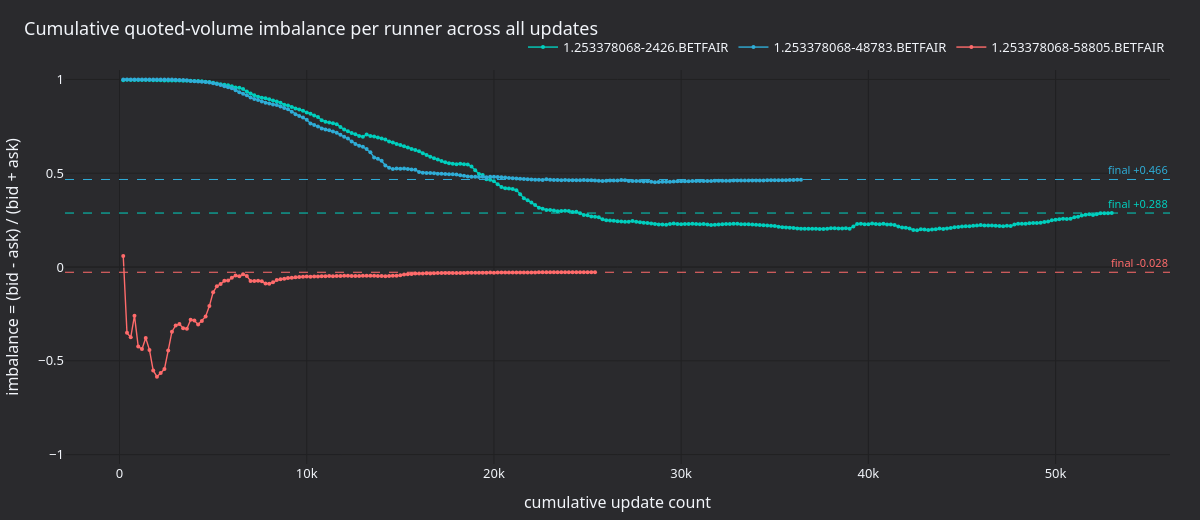
Figure 1. Cumulative (bid - ask) / (bid + ask) per runner across the
~143k updates of the market lifetime. Dashed lines mark each runner's final
imbalance.
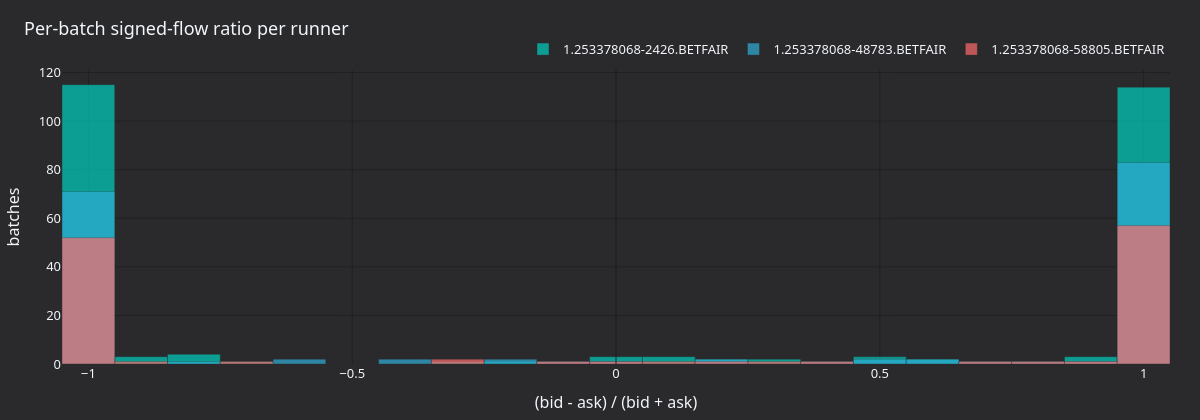
Figure 2. Distribution of per-batch signed flow ratio
(bid - ask) / (bid + ask) over LOG_INTERVAL = 200 batches per
runner. The shape of each runner's batch distribution is a sharper signal
than the cumulative imbalance.
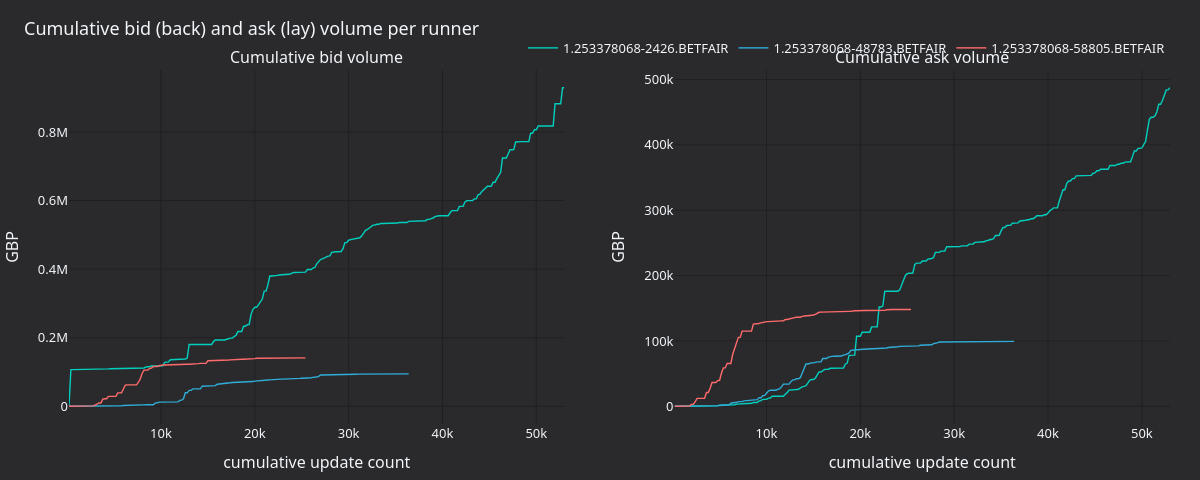
Figure 3. Cumulative back (bid) and lay (ask) volume per runner. Both sides are non-monotonic: lay flow occasionally outpaces back flow within short bursts even when cumulative imbalance stays positive.
Regenerate the panels
The actor logs [runner] update #N: batch bid=B ask=A cumulative imbalance=I
on every Nth update. The renderer parses those lines and writes static PNGs
using the nautilus_dark tearsheet theme.
Set the LOG_INTERVAL constant in betfair_backtest.rs to 200 first.
After building NautilusTrader from source, run these commands from the repository root:
make sync

cargo run -p nautilus-betfair --features examples --release \
    --example betfair-backtest > /tmp/betfair.log 2>&1

BETFAIR_LOG=/tmp/betfair.log \
    uv run --project python --no-sync \
        python docs/tutorials/assets/backtest_book_imbalance_betfair/render_panels.py
Running the example
# Debug build
cargo run -p nautilus-betfair --features examples --example betfair-backtest

# Release build (recommended)
cargo run -p nautilus-betfair --features examples --release --example betfair-backtest

# Custom data file
cargo run -p nautilus-betfair --features examples --release --example betfair-backtest -- path/to/file.gz

# Shipped sample file
cargo run -p nautilus-betfair --features examples --release --example betfair-backtest -- test_data/betfair/1-166811431.bz2
Complete source
The complete example is at
crates/adapters/betfair/examples/betfair_backtest.rs.
Next steps
- Add a strategy. Replace the actor with a
Strategyimplementation that places back/lay orders based on the imbalance signal. See theEmaCrossexample incrates/trading/src/examples/strategies/ema_cross/strategy.rsfor the pattern. - Use managed books. Set
managed: trueinsubscribe_book_deltasand read the full book viaself.cache().order_book(&id)for richer signals like top-of-book spread, depth ratios, or weighted mid-price. - Multiple markets. Load several
.gzfiles and run them through the same engine to test cross-market signals.
Delta-Neutral Options Strategy (Derive)
This tutorial runs the shared DeltaNeutralVol strategy with the Derive adapter. The shipped example discovers ETH options, selects an out-of-the-money call...
Composite Market Making on Lighter RWA with Databento US Equities NVDA
This tutorial runs the shipped [CompositeMarketMaker][composite-market-maker] strategy on Lighter's NVDA-PERP.LIGHTER RWA market using Databento NVDA.EQUS...