

Delta-Neutral Options Strategy (Bybit)
This Rust-only tutorial runs a live delta-neutral
short-volatility strategy on Bybit using the Rust LiveNode.
This tutorial runs a short out-of-the-money (OTM) strangle on Bybit BTC options and delta-hedges with the BTCUSDT perpetual. The strategy selects call and put strikes at startup and enters through implied-volatility limit orders. It tracks portfolio delta from venue-provided Greeks. When delta moves beyond a threshold, it submits market hedge orders on the perpetual.
This strategy trades real money on mainnet. Setting enter_strangle: false
only disables the initial strangle entry orders.
The strategy still loads existing positions from the cache at startup.
It still submits hedge orders on the perpetual when portfolio delta breaches the threshold.
If the account holds option or hedge positions from a prior
session, the strategy will trade.
Prerequisites
- Completion of the options data tutorial, which
covers instrument discovery, Greeks subscriptions, and the
DataActorpattern. - A Bybit API key with trading permissions for options and linear perpetuals.
- Environment variables for Bybit mainnet, which the example targets by default (see Running the example for testnet):
export BYBIT_API_KEY="your-api-key"
export BYBIT_API_SECRET="your-api-secret"
Strategy overview
The DeltaNeutralVol strategy ships in the trading crate's examples
module and runs in five stages:
- Strike selection: queries the instrument cache for all BTC options, filters to the nearest expiry, selects OTM call and put strikes by percentile rank.
- Entry: places SELL limit orders on both legs priced by implied
volatility (through Bybit's
order_ivparameter). Entry is optional and disabled by default in the example. - Greeks tracking: subscribes to
OptionGreeksfor both legs. Deltas and IVs come directly from Bybit's option ticker stream. - Rehedging: calculates portfolio delta and submits a market order on the BTCUSDT perpetual when the threshold is breached. Triggers on every Greeks update and on a periodic safety timer.
- Position tracking: tracks call, put, and hedge positions through
on_order_filled. Loads existing positions from the cache at startup.
Portfolio delta
The strategy calculates net exposure as:
portfolio_delta = call_delta * call_position
                + put_delta * put_position
                + hedge_position
A short strangle starts near delta-neutral because the call and put
deltas offset. With the default target_call_delta = 0.20 and
target_put_delta = -0.20, the two legs cancel at entry. As the
underlying moves, net delta drifts and the strategy hedges to bring it
back toward zero.
Configuration
The example file at
crates/adapters/bybit/examples/node_delta_neutral.rs
configures the strategy:
let hedge_instrument_id = InstrumentId::from("BTCUSDT-LINEAR.BYBIT");

let strategy_config = DeltaNeutralVolConfig::builder()
    .option_family("BTC".to_string())
    .hedge_instrument_id(hedge_instrument_id)
    .client_id(client_id)
    .contracts(1)
    .rehedge_delta_threshold(0.5)
    .rehedge_interval_secs(30)
    .enter_strangle(false)
    .iv_param_key("order_iv".to_string())
    .build();

let strategy = DeltaNeutralVol::new(strategy_config);
The table shows struct defaults and example overrides. The example overrides enter_strangle to false and
iv_param_key to "order_iv":
| Parameter | Default | Example | Description |
|---|---|---|---|
option_family | required | "BTC" | Underlying filter for instrument discovery. |
hedge_instrument_id | required | BTCUSDT-LINEAR | Perpetual used for delta hedging. |
client_id | required | "BYBIT" | Data and execution client identifier. |
target_call_delta | 0.20 | - | Target call delta for strike selection. |
target_put_delta | -0.20 | - | Target put delta for strike selection. |
contracts | 1 | - | Contracts per leg. |
rehedge_delta_threshold | 0.5 | - | Portfolio delta that triggers a hedge. |
rehedge_interval_secs | 30 | - | Periodic rehedge timer interval. |
enter_strangle | true | false | Place entry orders when Greeks arrive. |
entry_iv_offset | 0.0 | - | Vol points below mark IV for entry pricing. |
iv_param_key | "px_vol" | "order_iv" | Adapter-specific IV parameter key. |
The iv_param_key differs between venues. Bybit uses order_iv, which the adapter maps to the orderIv
field in the place-order API. OKX uses px_vol. For IV-based order placement, set the correct key for the
venue.
Node setup
The example configures both data and execution clients with Option and
Linear product types:
let data_config = BybitDataClientConfig {
    api_key: None,
    api_secret: None,
    product_types: vec![BybitProductType::Option, BybitProductType::Linear],
    ..Default::default()
};

let exec_config = BybitExecutionClientConfig {
    api_key: None,
    api_secret: None,
    product_types: vec![BybitProductType::Option, BybitProductType::Linear],
    account_id: Some(account_id),
    ..Default::default()
};
Both product types are needed: Option for the strangle legs, Linear
for the BTCUSDT perpetual hedge instrument. The execution client requires
account_id for order identity tracking.
let mut node = LiveNode::builder(trader_id, environment)?
    .with_name("BYBIT-DELTA-NEUTRAL-001".to_string())
    .add_data_client(None, Box::new(data_factory), Box::new(data_config))?
    .add_exec_client(None, Box::new(exec_factory), Box::new(exec_config))?
    .with_reconciliation(true)
    .with_delay_post_stop_secs(5)
    .build()?;

node.add_strategy(strategy)?;
node.run().await?;
At startup, with_reconciliation(true) queries Bybit for open orders and positions. Reconciliation loads the
cache before the strategy starts. The strategy then loads any existing positions from a prior session.
How the strategy works
Strike selection
At startup, the strategy queries the cache for all option instruments that match option_family. It removes
expired options and selects the nearest expiry. It separates calls and puts, then sorts each list by strike
price.
The strategy selects strikes by percentile in the sorted list:
- Call: index =
(1.0 - target_call_delta) * count. With 0.20 target delta and 50 calls, this selects the 40th strike (80th percentile, OTM). - Put: index =
|target_put_delta| * count. With -0.20 target delta, this selects the 10th strike (20th percentile, OTM).
This is a heuristic. Strike price ordering approximates delta ordering for options at the same expiry. A production strategy would subscribe to Greeks for all strikes first, then select by actual delta.
Entry via implied volatility
When enter_strangle is true and both mark IVs have arrived, the
strategy places SELL limit orders using the order_iv parameter:
let mut call_params = Params::new();
call_params.insert("order_iv".to_string(), json!(call_entry_iv.to_string()));

self.submit_order(call_order, None, Some(client_id), Some(call_params))?;
Bybit converts orderIv to a limit price on the server and gives it priority over any explicit price. The
entry_iv_offset setting subtracts vol points from mark IV. An offset of 0.02 sells two vol points below mark
for faster fills.
In Bybit's demo environment, new orders carry order_iv through the HTTP create-order endpoint.
Demo does not support order amendments through order_iv.
The adapter discards the modification with a warning before it reaches the API.
Rehedging
Two triggers check portfolio delta:
- Greeks updates: On each update,
on_option_greeksupdates the leg's delta value, then calculates portfolio delta again. - Periodic timer: checks every
rehedge_interval_secs, including when Greeks updates stop.
When |portfolio_delta| > rehedge_delta_threshold, the strategy submits
a market order on the hedge instrument. A hedge_pending flag prevents
duplicate submissions while an order is in flight.
Position tracking
The strategy tracks positions through on_order_filled. It does not query the cache on every tick. Each fill
updates the corresponding position counter (call, put, or hedge).
At startup, the strategy loads the counters from the cache that reconciliation populates. For the selected call, selected put, and hedge instrument, it sums the signed quantity of every open position. It does not filter by strategy, so positions opened elsewhere on those instruments count. Option positions on other strikes do not count.
Use an account with no unrelated positions on the hedge instrument.
At startup, the strategy treats any open BTCUSDT-LINEAR position as part of the hedge.
With no option positions, an unrelated perpetual position larger than rehedge_delta_threshold exceeds the threshold
once Greeks arrive for both legs. The strategy then submits a market order to close that position.
Shutdown
On stop the strategy cancels open orders, unsubscribes from all data feeds, and resets the hedge-pending flag. It does not close positions. To close the strangle and hedge, use manual action or a separate exit strategy.
What the run produces
A 30-second mainnet run with enter_strangle: false against a clean
account places no orders. The strategy logs the discovered instruments
and the strike selection:
Selected call: BTC-28APR26-81000-C-USDT-OPTION.BYBIT (strike=81000)
Selected put: BTC-28APR26-75000-P-USDT-OPTION.BYBIT (strike=75000)
Strangle: 1 contracts per leg, hedge on BTCUSDT-LINEAR.BYBIT
The log shows instrument discovery and strike selection. The panels below show the mechanics around the actual selected strikes (75,000 / 81,000) at the captured underlying.
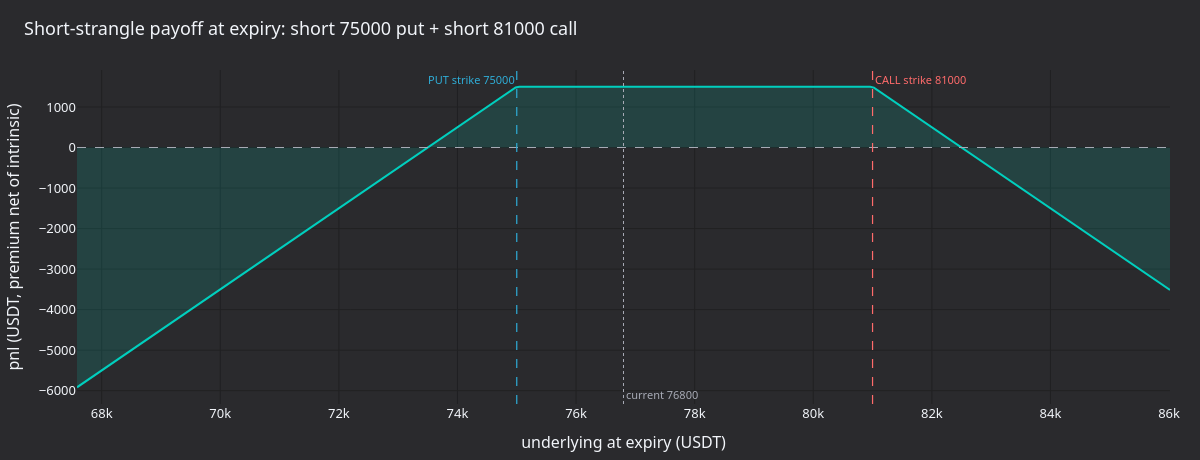
Figure 1. Pnl at expiry of the short 75,000 PUT plus short 81,000 CALL combination, assuming a 1,500 USDT total premium and zero discount. The flat top is the credit-only zone between strikes. Loss increases linearly past either strike.
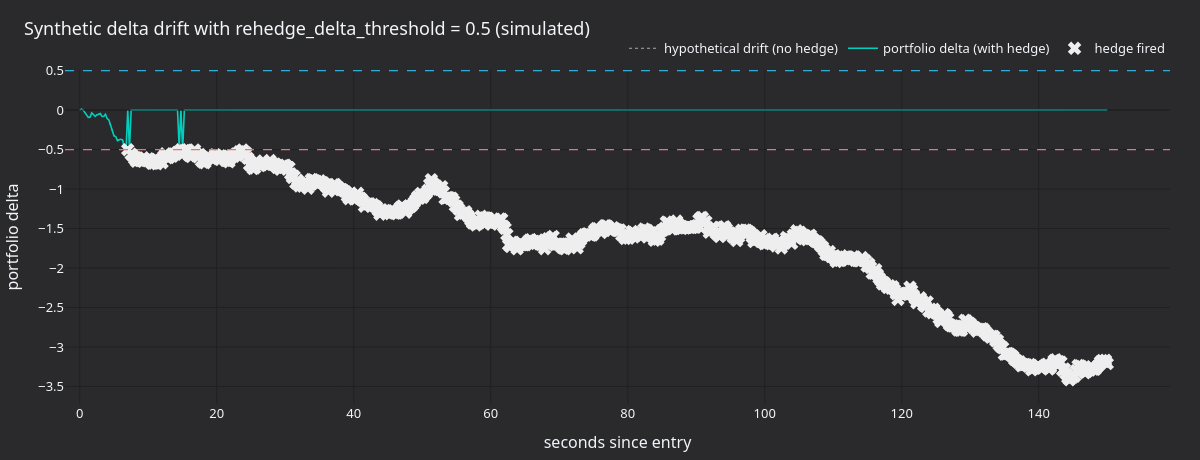
Figure 2. Synthetic Brownian delta drift over 150 seconds with rehedge_delta_threshold=0.5. The dotted
curve is the unhedged drift. The line is the strategy's portfolio delta after each market hedge (crosses).
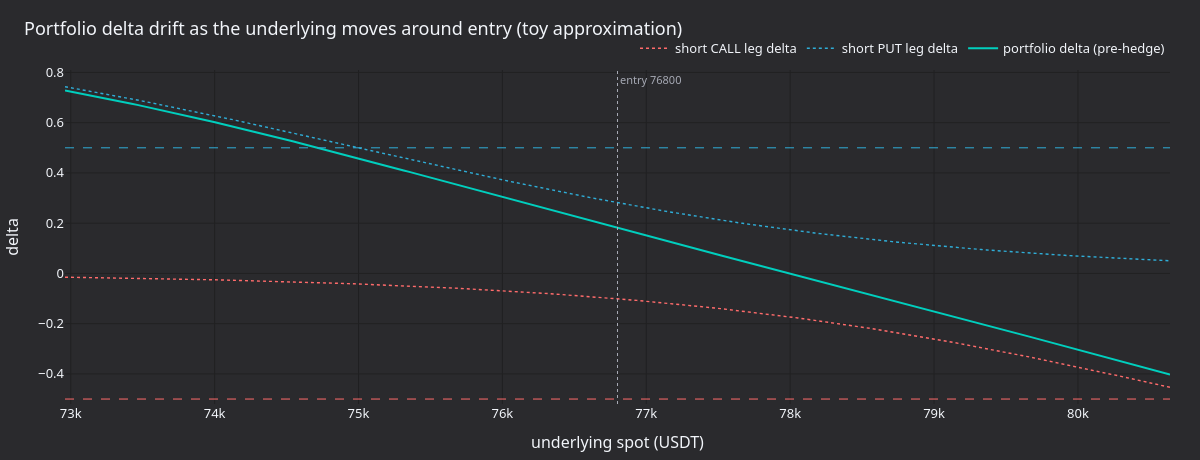
Figure 3. Illustrative short call and short put deltas across a 5% spot range around entry. The panel also shows the resulting portfolio delta before hedging. Negative gamma compresses the curve in the wings and steepens it across the strikes.
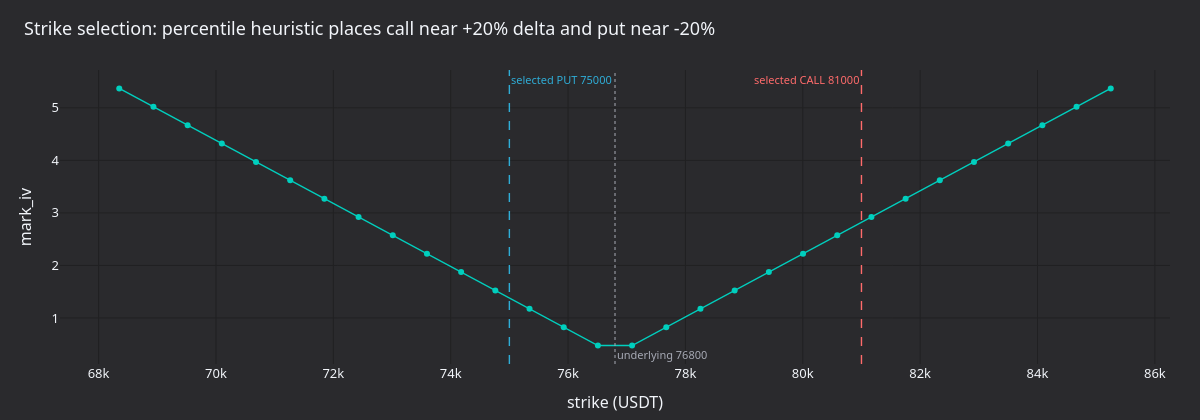
Figure 4. The strike-selection heuristic against an illustrative IV smile. The CALL strike is at the (1 - 0.20) percentile and the PUT at the 0.20 percentile. Both legs are OTM with approximately equal-magnitude deltas around the underlying.
Regenerate the panels
The log comes from bybit-delta-neutral, the live trading binary. It connects to Bybit mainnet with your API
keys. With the default config, it places no entry orders. It submits hedge orders if the account holds
positions on the selected legs or the hedge instrument.
After building NautilusTrader from source, run these commands from the repository root:
make sync

cargo build --release --example bybit-delta-neutral --package nautilus-bybit --features examples
timeout 30 ./target/release/examples/bybit-delta-neutral > /tmp/bybit_dn.log 2>&1

DN_LOG=/tmp/bybit_dn.log \
    uv run --project python --no-sync \
        python docs/tutorials/assets/delta_neutral_options_bybit/render_panels.py
The renderer parses selected strikes from the log. The panels are illustrative: the captured run uses a clean account and places no orders.
Risk considerations
- Gamma risk: a short strangle has negative gamma. Large underlying
moves increase delta exposure faster than the rehedge timer responds.
Tighten
rehedge_delta_thresholdand reducerehedge_interval_secsfor faster response, at the cost of more hedge trades. - Vega risk: an IV spike increases mark-to-market loss on the short options. The strategy does not manage vega exposure.
- Liquidity: OTM crypto options can have wide spreads. Hedge quality degrades when the underlying gaps or the perpetual trades in coarse size increments.
- Lifecycle risk: stopping the strategy stops hedging. Positions remain open and unhedged until manually managed.
Running the example
The example trades on Bybit mainnet by default. It has no network
constant: both client configs use ..Default::default(), which selects
BybitEnvironment::Mainnet and reads BYBIT_API_KEY and
BYBIT_API_SECRET. To run on testnet:
- Import
BybitEnvironmentfromnautilus_bybit::common::enumsinnode_delta_neutral.rs. - Add
environment: BybitEnvironment::Testnetto bothdata_configandexec_config. - Rebuild the example.
On testnet, the adapter reads BYBIT_TESTNET_API_KEY and BYBIT_TESTNET_API_SECRET.
cargo run --example bybit-delta-neutral --package nautilus-bybit --features examplesThe example runs with enter_strangle: false by default, so it does not place strangle entry orders. It still
loads existing positions and submits hedge orders if portfolio delta breaches the threshold. On a clean
account with no prior positions, the strategy places no orders.
Stop with Ctrl+C. The strategy cancels open orders and unsubscribes before shutdown.
Complete source
- Example runner:
crates/adapters/bybit/examples/node_delta_neutral.rs - Strategy implementation:
crates/trading/src/examples/strategies/delta_neutral_vol/ - Strategy README with full config reference:
crates/trading/src/examples/strategies/delta_neutral_vol/README.md
See also
- Options data and Greeks on Bybit: prerequisite tutorial covering Greeks subscriptions and option chain snapshots.
- Options: option instrument types and data architecture.
- Bybit integration: options
order parameters including
order_ivandmmp.
Options Data and Greeks (Bybit)
This tutorial connects to Bybit's live options market and consumes Greeks and option chain data through two DataActor examples. It covers instrument...
Delta-Neutral Options Strategy (Derive)
This tutorial runs the shared DeltaNeutralVol strategy with the Derive adapter. The shipped example discovers ETH options and selects an out-of-the-money...