

Options Data and Greeks (Bybit)
This Rust-only tutorial uses the Rust LiveNode
with the Bybit adapter to stream live option Greeks and aggregated chain
snapshots.
This tutorial connects to Bybit's live options market and consumes Greeks
and option chain data through two DataActor examples. It covers
instrument discovery, venue-provided Greeks subscriptions, and periodic
chain snapshots with ATM-relative strike filtering.
Introduction
Bybit publishes Greeks (delta, gamma, vega, theta) and implied volatility alongside every option ticker update. NautilusTrader exposes this data at two levels:
- Per-instrument Greeks: subscribe to a single option contract and
receive an
OptionGreeksevent on every ticker update. - Option chain snapshots: subscribe to an entire expiry series and
receive periodic
OptionChainSliceevents that aggregate quotes and Greeks across all active strikes.
Two example binaries show these patterns. The first subscribes to individual Greeks streams. The second subscribes to an aggregated chain with ATM-relative strike filtering.
Prerequisites
- A working Rust toolchain (rustup.rs).
- The NautilusTrader repository cloned and building.
The examples need no Bybit API key. They leave api_key and api_secret unset. The data client then uses
Bybit's public market data endpoints. It does not read credentials from the environment.
Bybit demo trading uses stream-demo.bybit.com only for private streams.
Public option market data uses the mainnet public stream
wss://stream.bybit.com/v5/public/option.
The DataActor pattern
A Rust DataActor needs three pieces:
- A struct with a
core: DataActorCorefield plus your own state. - The
nautilus_actor!(YourType)macro plus aDebugimplementation. - A
DataActortrait implementation with your callbacks.
The macro supplies the native runtime connections that the blanket Actor and Component implementations
require. You only implement the callbacks you need. Every callback has a default no-op implementation.
Part 1: per-instrument Greeks
The bybit-greeks-tester example subscribes to OptionGreeks for all
BTC CALL options at the nearest expiry and logs each update.
Actor structure
#[derive(Debug)]
struct GreeksTester {
    core: DataActorCore,
    client_id: ClientId,
    subscribed_instruments: Vec<InstrumentId>,
}

nautilus_actor!(GreeksTester);

impl GreeksTester {
    fn new(client_id: ClientId) -> Self {
        Self {
            core: DataActorCore::new(DataActorConfig {
                actor_id: Some("GREEKS_TESTER-001".into()),
                ..Default::default()
            }),
            client_id,
            subscribed_instruments: Vec::new(),
        }
    }
}
The macro requires the core field. The client_id identifies the data client for subscriptions. The
subscribed_instruments vector records subscriptions so the actor can remove them on stop.
Discovering instruments
On start, the actor queries the cache for all option instruments, filters for BTC CALLs that have not expired, and finds the nearest expiry:
fn on_start(&mut self) -> anyhow::Result<()> {
    let venue = Venue::new("BYBIT");
    let underlying_filter = Ustr::from("BTC");

    let mut options: Vec<(InstrumentId, f64, u64)> = {
        let cache = self.cache();
        let instruments = cache.instruments(&venue, Some(&underlying_filter));

        instruments
            .iter()
            .filter_map(|inst| {
                if inst.option_kind() == Some(OptionKind::Call) {
                    let expiry = inst.expiration_ns()?.as_u64();
                    let strike = inst.strike_price()?.as_f64();
                    Some((inst.id(), strike, expiry))
                } else {
                    None
                }
            })
            .collect()
    }; // cache borrow dropped here

    let now_ns = self.timestamp_ns().as_u64();
    options.retain(|(_, _, exp)| *exp > now_ns);

    let nearest_expiry = options.iter().map(|(_, _, exp)| *exp).min().unwrap();
    options.retain(|(_, _, exp)| *exp == nearest_expiry);
    options.sort_by(|(_, a, _), (_, b, _)| a.partial_cmp(b).unwrap());

    // ...subscribe to each
}
Release the cache borrow before calling any subscription methods. The
cache uses Rc<RefCell<...>> internally, and subscription methods may
need to borrow it. Collect owned data into a local Vec, drop the cache
reference, then subscribe.
Subscribing to Greeks
After discovering instruments, subscribe to each one:
let client_id = self.client_id;
for (instrument_id, _, _) in &options {
    self.subscribe_option_greeks(*instrument_id, Some(client_id), None);
    self.subscribed_instruments.push(*instrument_id);
}
Handling updates
Each ticker update from Bybit triggers on_option_greeks with an
OptionGreeks event:
fn on_option_greeks(&mut self, greeks: &OptionGreeks) -> anyhow::Result<()> {
    log::info!(
        "GREEKS | {} | delta={:.4} gamma={:.6} vega={:.4} theta={:.4} rho={:.6} | \
         mark_iv={} bid_iv={} ask_iv={} | underlying={} oi={}",
        greeks.instrument_id,
        greeks.delta,
        greeks.gamma,
        greeks.vega,
        greeks.theta,
        greeks.rho,
        greeks.mark_iv.map_or("-".to_string(), |v| format!("{v:.2}")),
        greeks.bid_iv.map_or("-".to_string(), |v| format!("{v:.2}")),
        greeks.ask_iv.map_or("-".to_string(), |v| format!("{v:.2}")),
        greeks.underlying_price.map_or("-".to_string(), |v| format!("{v:.2}")),
        greeks.open_interest.map_or("-".to_string(), |v| format!("{v:.1}")),
    );
    Ok(())
}
The OptionGreeks fields:
| Field | Type | Description |
|---|---|---|
instrument_id | InstrumentId | The option contract. |
convention | GreeksConvention | Greeks convention (BlackScholes or PriceAdjusted). |
delta | f64 | Price sensitivity to underlying. |
gamma | f64 | Delta sensitivity to underlying. |
vega | f64 | Price sensitivity to a 1% change in volatility. |
theta | f64 | Daily time decay. |
rho | f64 | Sensitivity to interest rate changes. |
mark_iv | Option<f64> | Mark price implied volatility. |
bid_iv | Option<f64> | Bid implied volatility. |
ask_iv | Option<f64> | Ask implied volatility. |
underlying_price | Option<f64> | Venue reference price for this expiry. |
open_interest | Option<f64> | Open interest for this contract. |
ts_event | UnixNanos | UNIX timestamp (nanoseconds) when the event occurred. |
ts_init | UnixNanos | UNIX timestamp (nanoseconds) when the instance was initialized. |
The delta, gamma, vega, theta, and rho values are in a nested greeks: OptionGreekValues struct.
The OptionGreeks implementation of Deref<Target = OptionGreekValues> permits direct access through
greeks.delta and the other fields, as shown above.
Bybit does not provide rho. The adapter sets it to 0.0.
Cleanup
On stop, unsubscribe from all instruments:
fn on_stop(&mut self) -> anyhow::Result<()> {
    let ids: Vec<InstrumentId> = self.subscribed_instruments.drain(..).collect();
    let client_id = self.client_id;
    for instrument_id in ids {
        self.unsubscribe_option_greeks(instrument_id, Some(client_id), None);
    }
    log::info!("Unsubscribed from all option greeks");
    Ok(())
}
Part 2: option chain snapshots
The bybit-option-chain example subscribes to an aggregated option chain
and logs periodic snapshots showing calls and puts at each strike with
their quotes and Greeks.
Why use option chains
Per-instrument subscriptions give control over individual contracts. For an entire surface, you must manage
individual streams and correlate updates across strikes. An option chain subscription does this through the
DataEngine. It aggregates quotes and Greeks across all strikes in a series and publishes a single
OptionChainSlice on a timer.
This aggregation occurs inside NautilusTrader. Bybit publishes option market data for each contract. The V5 public WebSocket documentation does not specify a native option chain stream.
Chain types
OptionSeriesId identifies a single expiry series:
let series_id = OptionSeriesId::new_derived(
    Venue::new("BYBIT"),    // venue
    Ustr::from("BTC"),      // underlying
    Ustr::from("USDT"),     // settlement currency
    UnixNanos::from(expiry), // expiration timestamp
);
StrikeRange controls which strikes are active:
| Variant | Description |
|---|---|
Fixed | A fixed set of strike prices. |
AtmRelative | strikes_above above and strikes_below below ATM. |
AtmPercent | All strikes within pct of the ATM price. |
Delta | Strikes whose call or put absolute delta is within tolerance of target. |
For dynamic strike ranges, subscriptions wait until the engine determines the ATM price from the venue-provided reference price.
Subscribing
let strike_range = StrikeRange::AtmRelative {
    strikes_above: 3,
    strikes_below: 3,
};

let snapshot_interval_ms = Some(5_000); // snapshot every 5 seconds

self.subscribe_option_chain(
    series_id,
    strike_range,
    snapshot_interval_ms,
    Some(client_id),
    None, // params
);
For raw mode, pass None for snapshot_interval_ms. In this mode, every quote or Greeks update publishes a
slice immediately.
Handling snapshots
The on_option_chain callback receives an OptionChainSlice containing
all active strikes with their call and put data:
fn on_option_chain(&mut self, slice: &OptionChainSlice) -> anyhow::Result<()> {
    log::info!(
        "OPTION_CHAIN | {} | atm={} | calls={} puts={} | strikes={}",
        slice.series_id,
        slice.atm_strike.map_or("-".to_string(), |p| format!("{p}")),
        slice.call_count(),
        slice.put_count(),
        slice.strike_count(),
    );

    for strike in slice.strikes() {
        let call_info = slice.get_call(&strike).map(|d| {
            let greeks_str = d.greeks.as_ref().map_or("-".to_string(), |g| {
                format!(
                    "d={:.3} g={:.5} v={:.2} iv={:.1}%",
                    g.delta, g.gamma, g.vega,
                    g.mark_iv.unwrap_or(0.0) * 100.0,
                )
            });
            format!("bid={} ask={} [{}]", d.quote.bid_price, d.quote.ask_price, greeks_str)
        });

        let put_info = slice.get_put(&strike).map(|d| {
            let greeks_str = d.greeks.as_ref().map_or("-".to_string(), |g| {
                format!(
                    "d={:.3} g={:.5} v={:.2} iv={:.1}%",
                    g.delta, g.gamma, g.vega,
                    g.mark_iv.unwrap_or(0.0) * 100.0,
                )
            });
            format!("bid={} ask={} [{}]", d.quote.bid_price, d.quote.ask_price, greeks_str)
        });

        log::info!(
            "  K={} | CALL: {} | PUT: {}",
            strike,
            call_info.unwrap_or_else(|| "-".to_string()),
            put_info.unwrap_or_else(|| "-".to_string()),
        );
    }

    Ok(())
}
The OptionChainSlice fields and methods:
| Name | Type / Returns | Description |
|---|---|---|
series_id | OptionSeriesId | The series this snapshot covers. |
atm_strike | Option<Price> | ATM strike from the reference price. |
call_count() | usize | Number of call strikes with data. |
put_count() | usize | Number of put strikes with data. |
strike_count() | usize | Union of all strikes. |
strikes() | Vec<Price> | Sorted list of all strike prices. |
get_call(k) | Option<&OptionStrikeData> | Call quote and Greeks at strike k. |
get_put(k) | Option<&OptionStrikeData> | Put quote and Greeks at strike k. |
Each OptionStrikeData contains a quote: QuoteTick (bid/ask) and an
optional greeks: Option<OptionGreeks>.
Node setup
Both examples use the same LiveNode pattern. No execution client is
needed for data-only use:
#[tokio::main]
async fn main() -> Result<(), Box<dyn std::error::Error>> {
    dotenvy::dotenv().ok();

    let environment = Environment::Live;
    let trader_id = TraderId::from("TESTER-001");
    let client_id = ClientId::new("BYBIT");

    let bybit_config = BybitDataClientConfig {
        api_key: None,    // public market data needs no credentials
        api_secret: None,
        product_types: vec![BybitProductType::Option],
        ..Default::default()
    };

    let client_factory = BybitDataClientFactory::new();

    let mut node = LiveNode::builder(trader_id, environment)?
        .with_name("BYBIT-OPTIONS-001".to_string())
        .add_data_client(None, Box::new(client_factory), Box::new(bybit_config))?
        .with_delay_post_stop_secs(5)
        .build()?;

    let actor = GreeksTester::new(client_id); // or OptionChainTester
    node.add_actor(actor)?;
    node.run().await?;

    Ok(())
}
With product_types set to [BybitProductType::Option], the client loads only option instruments. Startup
waits while the instrument provider retrieves and parses every listed option.
Running the examples
# Per-instrument Greeks
cargo run --example bybit-greeks-tester --package nautilus-bybit --features examples

# Option chain snapshots
cargo run --example bybit-option-chain --package nautilus-bybit --features examples
Stop either example with Ctrl+C. The actor's on_stop callback
unsubscribes from all streams before shutdown.
What the examples produce
A 30-second mainnet run on April 28 (BTC near 76,800 USDT, expiry 2026-04-28 08
UTC) gives these results:- The per-instrument tester captures 938 Greeks updates across 22 BTC CALL contracts.
- The chain tester captures 5 chain snapshots with 7 strikes each.
Per-instrument Greeks output
Found 22 BTC CALL options at nearest expiry (ts=1777359600000000000)
Subscribed to option greeks for 22 instruments
GREEKS | BTC-28APR26-72000-C-USDT-OPTION.BYBIT | delta=0.4733 gamma=0.000000 vega=0.0000 theta=-0.0000 rho=0.000000 | mark_iv=0.66 bid_iv=0.00 ask_iv=5.00 | underlying=76782.43 oi=0.0
GREEKS | BTC-28APR26-71000-C-USDT-OPTION.BYBIT | delta=0.4733 gamma=0.000000 vega=0.0000 theta=-0.0000 rho=0.000000 | mark_iv=0.74 bid_iv=0.00 ask_iv=5.00 | underlying=76782.43 oi=0.1
GREEKS | BTC-28APR26-73000-C-USDT-OPTION.BYBIT | delta=0.4733 gamma=0.000000 vega=0.0000 theta=-0.0000 rho=0.000000 | mark_iv=0.57 bid_iv=0.00 ask_iv=5.00 | underlying=76782.43 oi=0.0
Option chain output
OPTION_CHAIN | BYBIT:BTC:USDT:2026-04-28T08:00:00Z | atm=77000 | calls=7 puts=7 | strikes=7
  K=75500 | CALL: bid=1210 ask=1430 [d=0.445 g=0.00000 v=0.00 iv=36.2%] | PUT: bid=0 ask=5 [d=0.000 g=0.00000 v=0.00 iv=36.2%]
  K=76000 | CALL: bid=700 ask=850 [d=0.445 g=0.00000 v=0.00 iv=32.5%] | PUT: bid=0 ask=5 [d=0.000 g=0.00000 v=0.00 iv=32.5%]
  K=76500 | CALL: bid=265 ask=370 [d=0.442 g=0.00000 v=0.07 iv=29.9%] | PUT: bid=0 ask=5 [d=-0.003 g=0.00000 v=0.07 iv=29.9%]
Panels
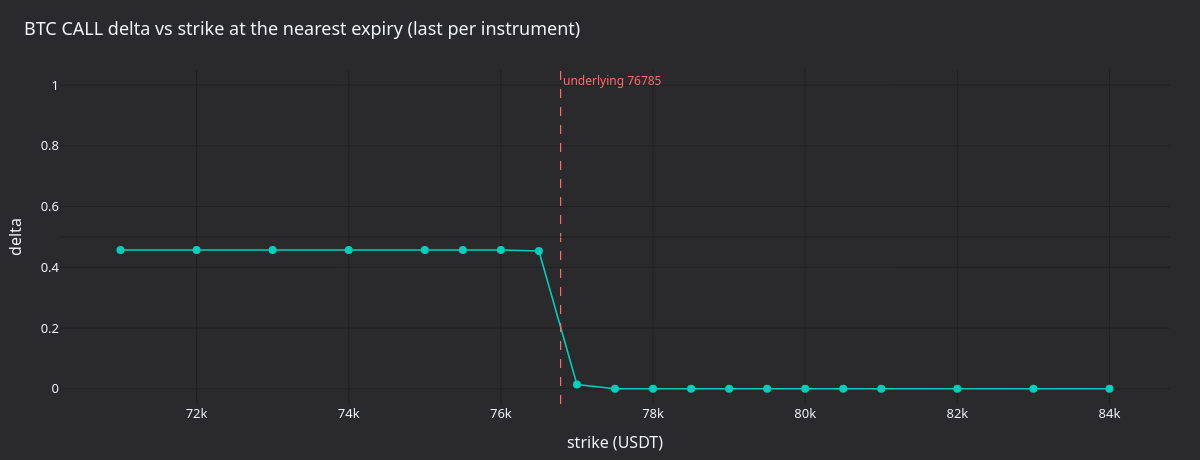
Figure 1. Last delta per BTC CALL strike at the nearest expiry, underlying ~77,000 USDT marked. Delta drops from ~0.45 below the underlying to near zero past the underlying. Bybit's delta on near-zero gamma contracts close to expiry compresses to a step-like profile around ATM.
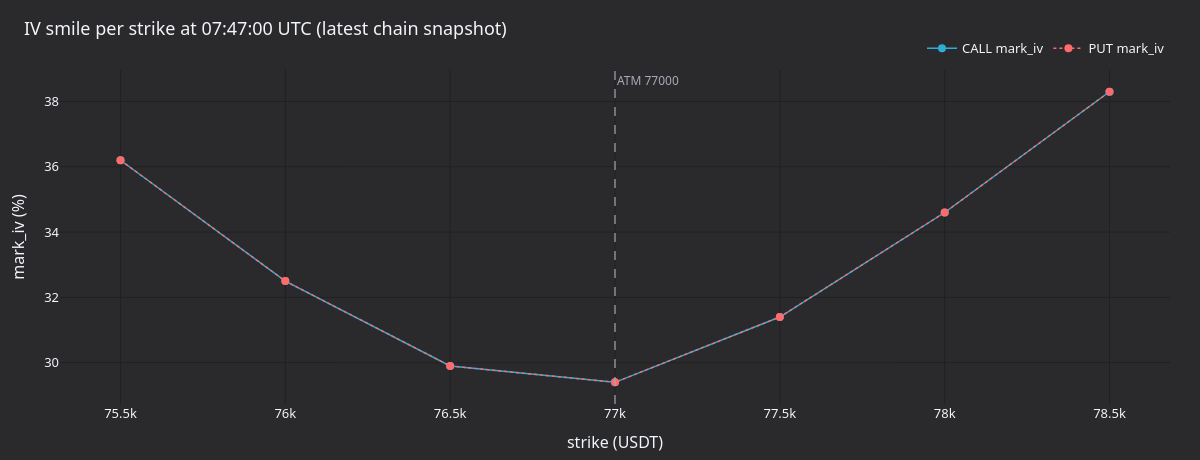
Figure 2. Mark IV per strike for the latest chain snapshot (CALL and PUT overlaid). The smile is symmetric around ATM at 77,000 USDT. IV decreases from 36% at 75,500 to 30% at 77,000, then increases to 38% at 78,500.
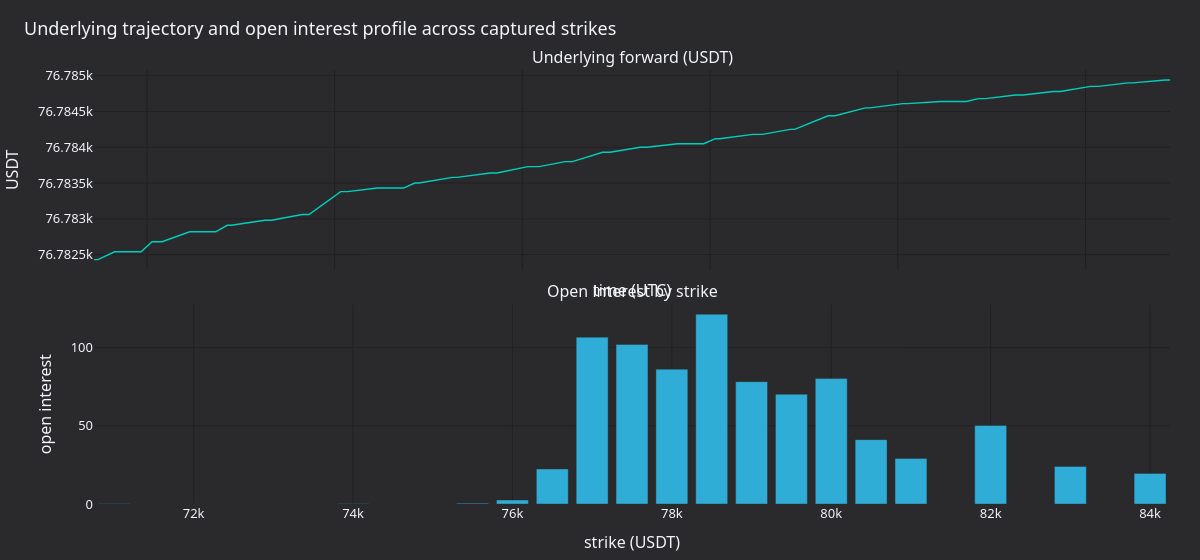
Figure 3. Bybit's underlying price reported in each Greeks update (top) and open interest by strike at the last update (bottom). OI concentrates in the [70,000, 76,000] USDT band: at-the-money to slightly out-of-the-money strikes.
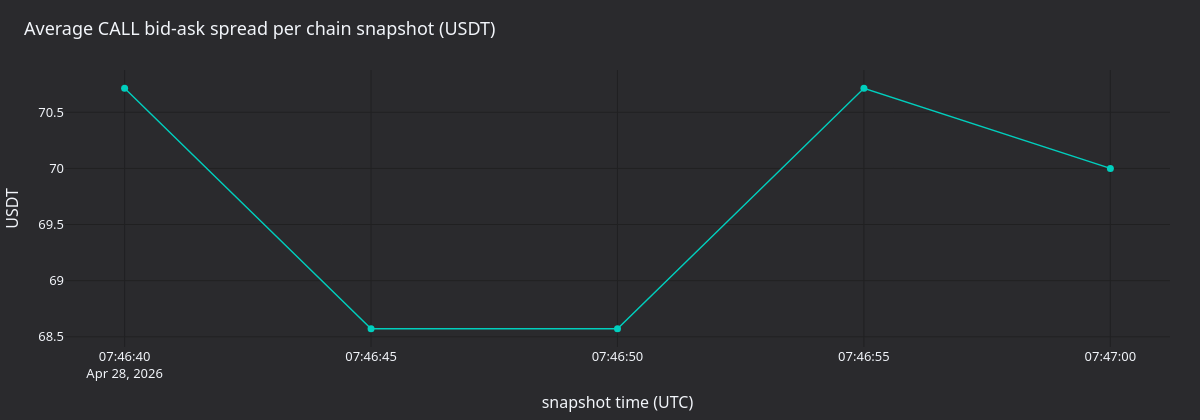
Figure 4. Average CALL bid-ask spread per chain snapshot in USDT.
Snapshots arrive every five seconds (snapshot_interval_ms=5000).
Regenerate the panels
After building NautilusTrader from source, run these commands from the repository root:
make sync

cargo build --release --package nautilus-bybit --features examples \
    --example bybit-greeks-tester --example bybit-option-chain
timeout 30 ./target/release/examples/bybit-greeks-tester > /tmp/bybit_greeks.log 2>&1
timeout 30 ./target/release/examples/bybit-option-chain > /tmp/bybit_chain.log 2>&1

GREEKS_LOG=/tmp/bybit_greeks.log CHAIN_LOG=/tmp/bybit_chain.log \
    uv run --project python --no-sync \
        python docs/tutorials/assets/options_data_bybit/render_panels.py
Complete source
Next steps
- Combined patterns: Use per-instrument Greeks for near-ATM contracts alongside the aggregated chain view in a single actor. Subscribe to Greeks for contracts you want to track individually, and the chain for a surface-level view.
- Quote subscriptions: Call
subscribe_quotesfor top-of-bookQuoteTickupdates on individual option contracts. - Options execution: The
delta-neutral strategy tutorial walks
through a short strangle with perpetual hedging, including IV-based
order placement through Bybit's
order_ivparameter.
See also
- Options: option instrument types, Greeks data types, and chain architecture.
- Bybit integration: full Bybit adapter reference including options order parameters and limitations.
On-Chain Grid Market Making with Short-Term Orders (dYdX)
This tutorial runs the shipped GridMarketMaker strategy on dYdX v4 through the Rust LiveNode. The strategy places symmetric limit orders around the mid and...
Delta-Neutral Options Strategy (Bybit)
This tutorial runs a short out-of-the-money (OTM) strangle on Bybit BTC options and delta-hedges with the BTCUSDT perpetual. The strategy selects call and...