

Backtest with Order Book Depth Data (Binance)
Replay Binance T_DEPTH order book deltas through BacktestNode and run an
imbalance strategy that fires fill-or-kill (FOK) limit orders when one side
of the book is much thicker than the other. The same pattern works against
any venue's L2 delta feed.
Introduction
Top-of-book imbalance is a microstructure signal: when the smaller resting
side at the BBO drops well below the larger side, the book is leaning. The
tutorial's OrderBookImbalance strategy works in two stages on every order
book update:
- Compute
min(bid_size, ask_size) / max(bid_size, ask_size). Higher means balanced; lower means leaning. - When the larger side exceeds
trigger_min_sizeand the ratio is belowtrigger_imbalance_ratio, fire a single FOK limit order against the thinner side: a buy at the best ask when bids are larger, otherwise a sell at the best bid. A trigger cooldown ofmin_seconds_between_triggersprevents the strategy from re-firing on every micro-update.
The strategy is intentionally simple and has no edge.
Prerequisites
- Python 3.12+
- NautilusTrader 2.x installed
(
pip install -U --pre nautilus_trader) - pandas (
pip install pandas). The wheel declares no runtime dependencies. - The sibling
orderbook_data.pyandorderbook_imbalance.pyfiles. Keep them next to this tutorial when downloading or converting it with Jupytext. - Optionally, Binance USD-M futures T_DEPTH CSVs that you supply for the day
you want to replay. The documented run uses BTCUSDT 2022-11-01, placed
under
NAUTILUS_DATA_DIR/Binance/(default~/Downloads/Data/Binance/). Without them the tutorial falls back to a 100-row sample of each file from the NautilusTrader test data, downloaded from GitHub on first run outside a source checkout. The sample runs end to end but is too short to trigger the strategy.
import os
import shutil
from decimal import Decimal
from pathlib import Path

import pandas as pd
from nautilus_trader.adapters.binance import load_binance_order_book_deltas
from nautilus_trader.backtest import BacktestNode
from nautilus_trader.common import LogLevel
from nautilus_trader.config import (
    BacktestDataConfig,
    BacktestEngineConfig,
    BacktestRunConfig,
    BacktestVenueConfig,
    ImportableStrategyConfig,
    LoggerConfig,
)
from nautilus_trader.core.datetime import dt_to_unix_nanos
from nautilus_trader.execution import MakerTakerFeeModel
from nautilus_trader.model import (
    AccountType,
    BookType,
    Currency,
    CurrencyPair,
    InstrumentId,
    NautilusDataType,
    OmsType,
    Price,
    Quantity,
    Symbol,
    Venue,
)
from nautilus_trader.persistence import ParquetDataCatalog

from orderbook_data import deltas_from_frame, sample_data_path
Loading data
Each row of _depth_snap.csv and _depth_update.csv is a single L2 level
event. load_binance_order_book_deltas returns a pandas DataFrame with one
row per event: snapshot rows (update_type="snap") become ADD actions
flagged F_SNAPSHOT, and update rows become UPDATE, or DELETE when the
quantity is zero. The full update file for BTCUSDT 2022-11-01 is ~12 GB
(~110 million rows), so the tutorial caps the read at 1,000,000 rows.
DATA_DIR = Path(os.environ.get("NAUTILUS_DATA_DIR", "~/Downloads/Data")).expanduser() / "Binance"path_snap = DATA_DIR / "BTCUSDT_T_DEPTH_2022-11-01_depth_snap.csv"
path_update = DATA_DIR / "BTCUSDT_T_DEPTH_2022-11-01_depth_update.csv"
if not (path_snap.is_file() and path_update.is_file()):
path_snap = sample_data_path("binance/btcusdt-depth-snap.csv")
path_update = sample_data_path("binance/btcusdt-depth-update.csv")
path_snap, path_update# Initial L2 snapshot of the book at session open.
df_snap = load_binance_order_book_deltas(path_snap)
df_snap.head()# Per-level deltas for the day; capped to 1M rows for a reasonable run time.
nrows = 1_000_000
df_update = load_binance_order_book_deltas(path_update, nrows=nrows)
df_update.head()Build current model objects
Define the instrument with the public model API, then convert each loader row
to an OrderBookDelta. Sort by ts_init so the data engine sees deltas in
true publication order regardless of how the snapshot and update files
interleave.
BTCUSDT_BINANCE = CurrencyPair(
    instrument_id=InstrumentId(Symbol("BTCUSDT"), Venue("BINANCE")),
    raw_symbol=Symbol("BTCUSDT"),
    base_currency=Currency.from_str("BTC"),
    quote_currency=Currency.from_str("USDT"),
    price_precision=2,
    size_precision=6,
    price_increment=Price(0.01, precision=2),
    size_increment=Quantity(0.000001, precision=6),
    ts_event=0,
    ts_init=0,
)

deltas = deltas_from_frame(df_snap, BTCUSDT_BINANCE)
deltas += deltas_from_frame(df_update, BTCUSDT_BINANCE)
deltas.sort(key=lambda x: x.ts_init)
deltas[:10]
Set up the data catalog
Persist the instrument and deltas to a fresh ParquetDataCatalog so the
BacktestNode can lazy-load by time range. The tutorial writes the catalog
to catalog/ under the working directory and replaces that directory on
each run.
CATALOG_PATH = Path.cwd() / "catalog"
if CATALOG_PATH.exists():
    shutil.rmtree(CATALOG_PATH)
CATALOG_PATH.mkdir()

catalog = ParquetDataCatalog(str(CATALOG_PATH))catalog.write_instruments([BTCUSDT_BINANCE])
catalog.write_order_book_deltas(deltas)catalog.instruments()start = dt_to_unix_nanos(pd.Timestamp("2022-11-01", tz="UTC"))
end = dt_to_unix_nanos(pd.Timestamp("2022-11-04", tz="UTC"))
deltas = catalog.query_order_book_deltas(
identifiers=[str(BTCUSDT_BINANCE.id)],
start=start,
end=end,
)
print(len(deltas))
deltas[:10]Configure the backtest
BacktestNode ingests data from the catalog and builds a BacktestEngine
per BacktestRunConfig. The venue book type must match the data: deltas
carry full L2 information so we use L2_MBP.
instrument = catalog.instruments()[0]
book_type = BookType.L2_MBP

data_configs = [
    BacktestDataConfig(
        catalog_path=str(CATALOG_PATH),
        data_type=NautilusDataType.OrderBookDelta,
        instrument_id=instrument.id,
    ),
]

venues_configs = [
    BacktestVenueConfig(
        name="BINANCE",
        oms_type=OmsType.NETTING,
        account_type=AccountType.CASH,
        base_currency=None,
        starting_balances=["20 BTC", "100000 USDT"],
        book_type=book_type,
        fee_model=MakerTakerFeeModel(
            maker_rate=Decimal("0.001"),
            taker_rate=Decimal("0.001"),
        ),
    ),
]

strategy_config = ImportableStrategyConfig(
    strategy_path="orderbook_imbalance:OrderBookImbalance",
    config_path="orderbook_imbalance:OrderBookImbalanceConfig",
    config={
        "instrument_id": str(instrument.id),
        "book_type": book_type.name,
        "max_trade_size": "1.000",
        "min_seconds_between_triggers": 1.0,
    },
)

config = BacktestRunConfig(
    engine=BacktestEngineConfig(
        logging=LoggerConfig(stdout_level=LogLevel.ERROR),
    ),
    data=data_configs,
    venues=venues_configs,
    dispose_on_completion=False,
)

config
Run the backtest
node = BacktestNode(configs=[config])
node.build()
node.add_strategy_from_config(config.id, strategy_config)

result = node.run()resultnode.generate_order_fills_report(config.id)node.generate_positions_report(config.id)node.generate_account_report(config.id, venue=Venue("BINANCE"))What the run produces
The figures below come from the full T_DEPTH files. The test data sample covers 100 rows of each, so it completes without firing any orders.
With one million updates the data spans roughly the first eleven minutes of the trading day after the initial snapshot is rebuilt. The renderer below uses three million updates (~25 minutes) so the panels show enough trigger events to be informative; the strategy fires the same way on the smaller default window.
Across the active update window the strategy submits 47 FOK limit orders and accumulates a net 14 BTC short. Every trigger lands on the bid side, implying ask size dominated bid size for nearly every imbalance event in the recorded window.
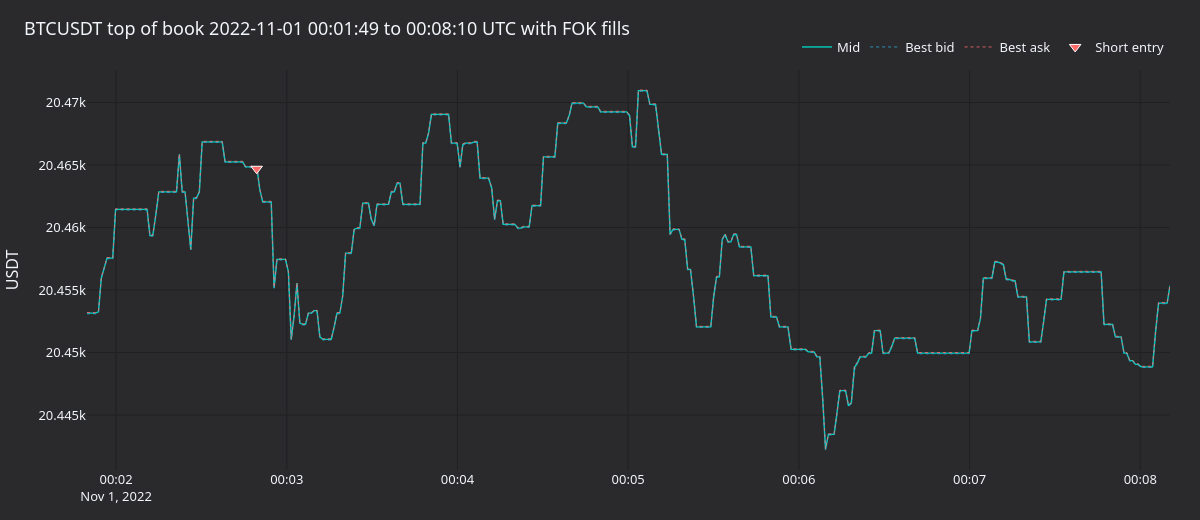
Figure 1. BTCUSDT mid, best bid, and best ask during the FOK trigger window. Triangles down are short entries at the bid; the cross is the closing fill. The strategy is on the bid side throughout.
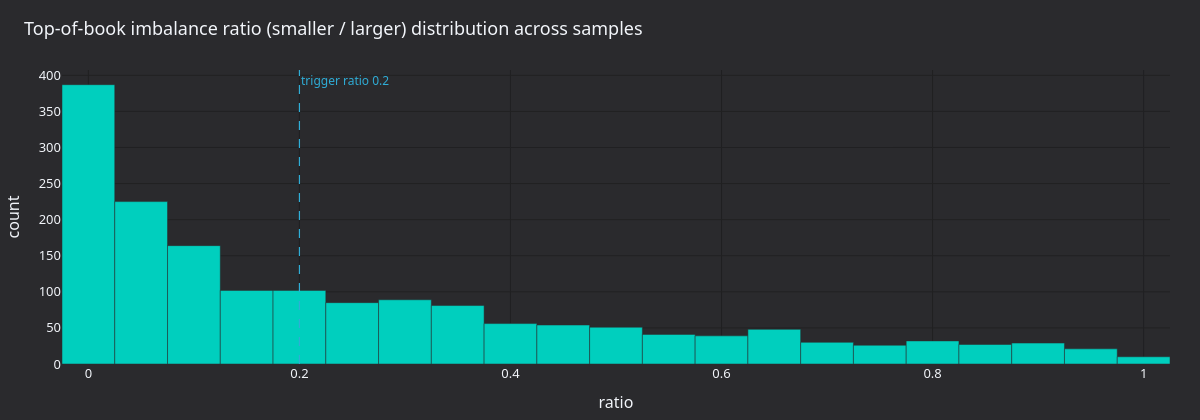
Figure 2. smaller / larger ratio across all sampled top-of-book
snapshots, with the 0.20 trigger threshold marked. The mass left of the
threshold is the addressable trigger region.
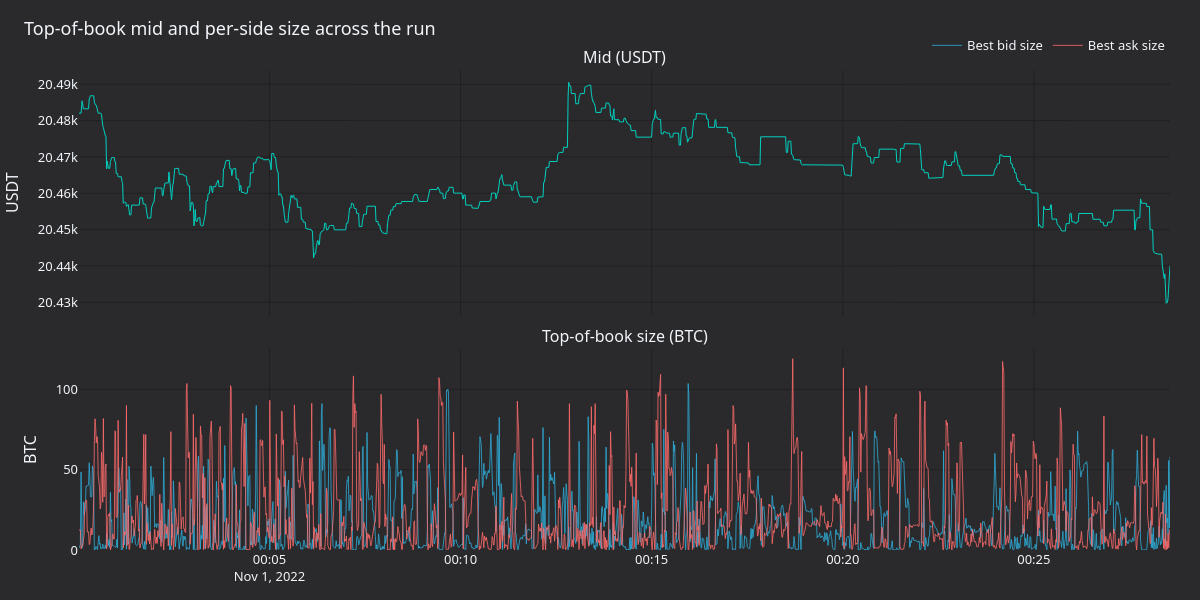
Figure 3. Mid price (top) and best bid/ask size in BTC (bottom) across the active update window. Top-of-book sizes oscillate over a wide range while the mid drifts in a narrow band.
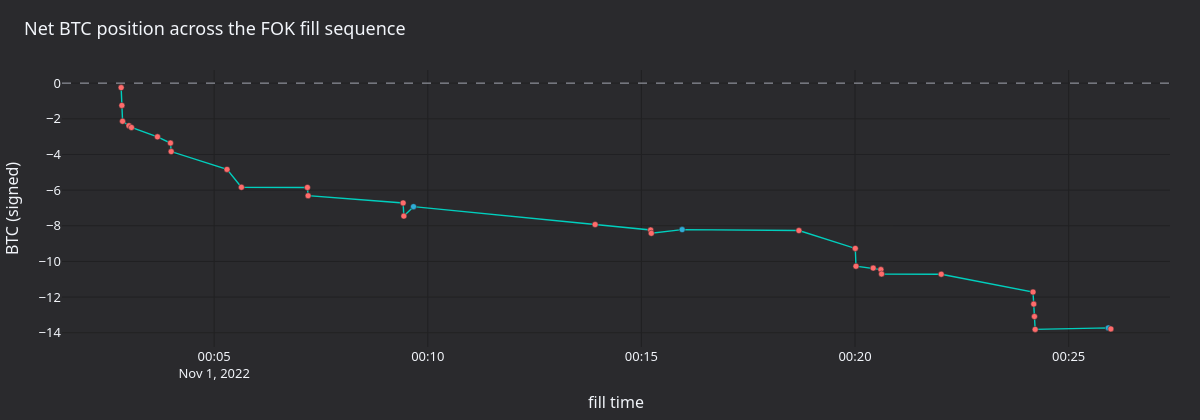
Figure 4. Cumulative signed BTC across the FOK fill sequence. Each marker is a fill; orange is a sell, blue is a buy. The strategy ramps into a -14 BTC short over 25 minutes.
Regenerate the panels
A self-contained renderer re-runs the backtest with a sampling actor that
captures top of book once per second, then writes PNG panels to the asset
directory using the shared nautilus_dark tearsheet theme.
After building NautilusTrader from source, run these commands from the repository root:
make sync
NAUTILUS_DATA_DIR=test_data/local \
    uv run --project python --no-sync \
        python docs/tutorials/assets/backtest_orderbook_binance/render_panels.py
Set NAUTILUS_DATA_DIR to wherever your Binance/ data directory lives.
Next steps
- Tighter trigger. Drop
trigger_imbalance_ratioto 0.10 to require a ten-to-one lean before firing. Expect far fewer entries and lower hit rate. - Longer window. Bump
nrowsto ten or twenty million to replay several hours and see the strategy stress against more diverse sessions. - Quote ticks instead of deltas. See the Gold Perpetual Book Imbalance tutorial for a quote-driven imbalance strategy.
Backtest with FX Bar Data
Run an EMA cross strategy on USD/JPY 1-minute bid/ask bars with FX rollover interest and a probabilistic fill model. The data comes from the NautilusTrader...
Backtest with Order Book Depth Data (Bybit)
Replay Bybit ob500 order book deltas through BacktestNode and run the OrderBookImbalance strategy. Same shape as the Binance variant, different loader and...