

Backtest with Pre-IPO Order Book Data (CoinAPI)
Download one hour of Lighter ANTHROPIC pre-IPO perpetual order book data from CoinAPI, load it into a Parquet catalog, and run an order book imbalance backtest. The download is cached locally, so later runs work offline.
This market provides synthetic exposure to Anthropic's pre-IPO valuation. Lighter normalizes the contract using an assumed share count of one billion and uses an internal pricing mechanism. The perpetual does not give ownership of company shares. See Lighter's market specifications and pre-IPO market rules.
Prerequisites
- Python 3.13, 3.14, or 3.15.
- NautilusTrader 2.x with the CoinAPI adapter:
pip install -U --pre nautilus_trader. - pandas:
pip install pandas. - A CoinAPI key with Flat Files access and sufficient usage credits for the first download. Listing and downloading files incur charges; see Flat Files access.
From a source checkout, run the tutorial from the repository root after building the Python extension:
uv run --project python --no-sync --with pandas \
python docs/tutorials/backtest_orderbook_coinapi.pyimport asyncio
import os
from decimal import Decimal
from getpass import getpass
from hashlib import file_digest
from pathlib import Path
from tempfile import mkdtemp
import pandas as pd
from nautilus_trader.adapters.coinapi import CoinApiDataLoader
from nautilus_trader.backtest import BacktestNode
from nautilus_trader.common import LogLevel
from nautilus_trader.config import BacktestDataConfig
from nautilus_trader.config import BacktestEngineConfig
from nautilus_trader.config import BacktestRunConfig
from nautilus_trader.config import BacktestVenueConfig
from nautilus_trader.config import DataCatalogConfig
from nautilus_trader.config import DataEngineConfig
from nautilus_trader.config import LoggerConfig
from nautilus_trader.execution import MakerTakerFeeModel
from nautilus_trader.model import AccountType
from nautilus_trader.model import BookAction
from nautilus_trader.model import BookType
from nautilus_trader.model import CryptoPerpetual
from nautilus_trader.model import Currency
from nautilus_trader.model import InstrumentId
from nautilus_trader.model import Money
from nautilus_trader.model import NautilusDataType
from nautilus_trader.model import OmsType
from nautilus_trader.model import OrderBook
from nautilus_trader.model import Price
from nautilus_trader.model import Quantity
from nautilus_trader.model import RecordFlag
from nautilus_trader.model import StandardMarginModel
from nautilus_trader.model import Symbol
from nautilus_trader.model import Venue
from nautilus_trader.persistence import ParquetDataCatalog
from nautilus_trader.trading import OrderBookImbalanceConfigDownload the full-book file
Use T-LIMITBOOK_FULL for a snapshot followed by all recorded updates.
The selected file covers [00:00, 01:00) UTC on 2026-10-01 and is about
279 KB compressed. Its CoinAPI symbol is LIGHTER_PERP_ANTHROPIC_USD.
CoinAPI stores this hour in the historical coinapi bucket. The
coinapi-daily-tail bucket retains only the previous day's daily files.
See the full-book file layout
when selecting another partition.
The first run reads COINAPI_API_KEY or prompts for the key without
echoing it. CoinApiDataLoader handles authentication and streams the
file to disk before making it available at the destination.
Files go under NAUTILUS_DATA_DIR/CoinAPI, which defaults to
~/Downloads/Data/CoinAPI.
The checksum pins the exact export used for the results below. A
mismatch stops the run before parsing; verify the file before replacing it.
In a notebook with an active event loop, replace
asyncio.run(download_file()) below with await download_file().
DATA_DIR = Path(os.environ.get("NAUTILUS_DATA_DIR", "~/Downloads/Data")).expanduser() / "CoinAPI"
OBJECT_KEY = (
    "T-LIMITBOOK_FULL/D-2026100100/E-LIGHTER/"
    "IDDI-47534074+SC-LIGHTER_PERP_ANTHROPIC_USD+S-ANTHROPIC.csv.gz"
)
FILE_SHA256 = "2ed141be6480c56ff16322e08bbc43398edc710875fe81093e0635ff672e48e4"
filepath = DATA_DIR / OBJECT_KEY

api_key = os.environ.get("COINAPI_API_KEY")
if not filepath.is_file() and not api_key:
    api_key = getpass("CoinAPI Flat Files API key: ")

loader = CoinApiDataLoader(api_key=api_key)

del api_key


async def download_file() -> None:
    """
    Download the selected export through the configured loader.
    """
    await loader.download_flat_file("coinapi", OBJECT_KEY, filepath)


if not filepath.is_file():
    asyncio.run(download_file())

with filepath.open("rb") as source:
    if file_digest(source, "sha256").hexdigest() != FILE_SHA256:
        raise ValueError(f"Unexpected SHA-256 for {filepath}; verify the selected export")

print(f"Data file: {filepath}")
Define the Lighter contract
CoinApiDataLoader uses a registered instrument definition. It does not
need the live client's instrument mapper, which does not support Lighter.
Use the native ID ANTHROPIC-PERP.LIGHTER and USDC for the quote and
settlement currency. CryptoPerpetual matches the native Lighter
adapter's model for this contract. CoinAPI's USD symbol suffix does not
change the native contract's settlement currency. Prices have one
decimal place and sizes have five in this export, matching the venue's
tick and lot increments.
For this simulation, set a minimum order of 0.00250 contract units, a minimum notional of 10 USDC, initial margin of 20%, and maintenance margin of 12%. These limits and margin rates are assumptions based on native metadata, not a reconstruction of historical venue rules. Verify the terms for your research period before drawing conclusions from PnL.
USDC = Currency.from_str("USDC")

instrument = CryptoPerpetual(
    instrument_id=InstrumentId.from_str("ANTHROPIC-PERP.LIGHTER"),
    raw_symbol=Symbol("ANTHROPIC"),
    base_currency=Currency.from_str("ANTHROPIC"),
    quote_currency=USDC,
    settlement_currency=USDC,
    is_inverse=False,
    price_precision=1,
    size_precision=5,
    price_increment=Price.from_str("0.1"),
    size_increment=Quantity.from_str("0.00001"),
    min_quantity=Quantity.from_str("0.00250"),
    min_notional=Money.from_decimal(Decimal(10), USDC),
    margin_init=Decimal("0.20"),
    margin_maint=Decimal("0.12"),
    ts_event=0,
    ts_init=0,
)

book_type = BookType.L2_MBP
Reconstruct the book and write the catalog
This file has empty order IDs, so it describes L2 market-by-price levels.
The loader emits a CLEAR and snapshot levels, followed by incremental
updates. F_LAST marks the end of each complete event.
Register the contract with CoinApiDataLoader so every chunk uses its
price and size precision. Local loading requires no credentials.
Stream the entire file in its original order. Do not set a row limit:
it can cut a snapshot or update event short. Streaming chunks preserve
event boundaries and may exceed chunk_size. The loader derives the UTC
date from the file's D-2026100100 directory; pass date explicitly if
you rename or move the file outside that partition.
Each run creates a separate catalog under DATA_DIR and prints its path.
Existing catalogs remain available for later research.
Level updates in CoinAPI exports can have separate timestamps. F_LAST
marks a loader event, not an atomic venue update. Other partitions can
briefly produce locked or crossed books while applying level changes.
Keep every delta in the catalog, but require a positive spread for both
the preview below and the strategy's trading decisions.
The opening snapshot and final book must pass integrity checks before
running the backtest.
catalog_path = Path(mkdtemp(prefix="lighter-anthropic-catalog-", dir=DATA_DIR))
catalog = ParquetDataCatalog(str(catalog_path))
catalog.write_instruments([instrument])

book = OrderBook(instrument.id, book_type)
top_of_book_rows = []
delta_count = 0
nonpositive_spread_count = 0

loader.add_instrument(instrument)

for chunk in loader.stream_book_deltas(
    filepath,
    instrument.id,
    chunk_size=100_000,
):
    if delta_count == 0:
        assert chunk[0].action == BookAction.CLEAR
        assert chunk[0].flags & RecordFlag.F_SNAPSHOT.value
    assert chunk[-1].flags & RecordFlag.F_LAST.value

    catalog.write_order_book_deltas(chunk)
    delta_count += len(chunk)

    for delta in chunk:
        book.apply_delta(delta)
        if not delta.flags & RecordFlag.F_LAST.value:
            continue

        if delta.flags & RecordFlag.F_SNAPSHOT.value:
            book.check_integrity()
        bid = book.best_bid_price()
        ask = book.best_ask_price()
        bid_size = book.best_bid_size()
        ask_size = book.best_ask_size()
        if bid is None or ask is None or bid_size is None or ask_size is None:
            continue

        spread = ask.as_decimal() - bid.as_decimal()
        if spread <= 0:
            nonpositive_spread_count += 1
            continue

        top_of_book_rows.append(
            {
                "ts_init": delta.ts_init,
                "bid": bid.as_decimal(),
                "ask": ask.as_decimal(),
                "spread": spread,
                "bid_size": bid_size.as_decimal(),
                "ask_size": ask_size.as_decimal(),
            },
        )

top_of_book = pd.DataFrame(top_of_book_rows)
top_of_book.index = pd.to_datetime(top_of_book.pop("ts_init"), unit="ns", utc=True)
book.check_integrity()
print(f"Catalog: {catalog_path}")
print(f"Loaded {delta_count:,} deltas, including the snapshot CLEAR")
print(f"Excluded {nonpositive_spread_count:,} locked or crossed states from the preview")
print(top_of_book.head())
print(f"Spread range: {top_of_book['spread'].min()} to {top_of_book['spread'].max()} USDC")
Configure the backtest
Replay the catalog with BacktestNode. The engine reads the initial
snapshot before updates, so it starts with a complete book. Starting a
replay partway through the hour would omit that snapshot.
Enable emit_quotes_from_book so the data engine caches top-of-book
quotes derived from the deltas. The risk engine needs these quotes to
price the strategy's market exit. Without them, it denies the closing
order with MARKET_PRICE_UNAVAILABLE and leaves the position open.
Use the built-in Rust OrderBookImbalance through Python, as in the Binance and Bybit tutorials.
When one best-quote size is less than 20% of the other and the larger exceeds
one contract unit, the strategy submits a fill-or-kill limit order
against the thinner side. Each order is at most 0.01 contract units,
with at least one second between triggers. The strategy closes its
position when it stops.
Use a simulated margin account with 100,000 USDC. StandardMarginModel
applies the instrument's 20% and 12% rates without a leverage reduction.
Maker and taker fees are explicitly zero for this teaching run.
Funding, network latency,
transaction costs, and IPO conversion or settlement are omitted.
L2 data cannot establish individual order queue positions, and simulated
fills do not predict live execution.
This strategy demonstrates the data workflow; it has no demonstrated edge.
config = BacktestRunConfig(
    engine=BacktestEngineConfig(
        logging=LoggerConfig(stdout_level=LogLevel.ERROR),
        data_engine=DataEngineConfig(emit_quotes_from_book=True),
    ),
    data=[
        BacktestDataConfig(
            catalog=DataCatalogConfig(path=str(catalog_path)),
            data_type=NautilusDataType.OrderBookDelta,
            instrument_id=instrument.id,
        ),
    ],
    venues=[
        BacktestVenueConfig(
            name="LIGHTER",
            oms_type=OmsType.NETTING,
            account_type=AccountType.MARGIN,
            starting_balances=["100000 USDC"],
            book_type=book_type,
            margin_model=StandardMarginModel(),
            fee_model=MakerTakerFeeModel(
                maker_rate=Decimal(0),
                taker_rate=Decimal(0),
            ),
        ),
    ],
    dispose_on_completion=False,
)

strategy_config = OrderBookImbalanceConfig(
    instrument_id=instrument.id,
    book_type=book_type,
    max_trade_size=Quantity.from_str("0.01000"),
    trigger_min_size=Decimal("1.0"),
    trigger_imbalance_ratio=Decimal("0.20"),
    min_seconds_between_triggers=1.0,
)
Run the backtest and inspect the results
The selected file produces 15,047 deltas. The default F_LAST batching
replays the 234-delta opening snapshot as one event, giving 14,814
backtest iterations. This configuration submits 234 orders, all filled.
Of these, 233 are fill-or-kill limit orders: 232 sells and one buy.
They build a short position with a peak size of 2.30689 contract units.
A final market buy closes it. The average opening and closing prices
are about 2120.30 and 2120.80 USDC, giving a realized loss of 1.157298 USDC
and a final balance of 99,998.84270200 USDC under these assumptions.
The reports show filled orders, positions, and account balances. Inspect commissions and final position exposure as well as PnL. The account report records balance changes; the position report contains realized PnL for closed positions. Order status counts include orders with no fills. A successful replay establishes that the data pipeline works, not that this strategy is profitable.
node = BacktestNode(configs=[config])
node.build()
node.add_builtin_strategy(config.id, "OrderBookImbalance", strategy_config)
results = node.run()

print(results)
orders = node.generate_orders_report(config.id)
fills = node.generate_order_fills_report(config.id)
executions = node.generate_fills_report(config.id)
positions = node.generate_positions_report(config.id)
account = node.generate_account_report(config.id, venue=Venue("LIGHTER"))
print(orders["status"].value_counts().to_string())
print(fills[["side", "filled_qty", "avg_px"]].head().to_string())
print(
    positions[
        [
            "entry",
            "side",
            "quantity",
            "peak_qty",
            "avg_px_open",
            "avg_px_close",
            "realized_pnl",
            "commissions",
        ]
    ].to_string(),
)
print(account[["total", "locked", "free", "currency"]].tail().to_string())node.dispose()Visualize the run
These panels use the same pinned export, complete hour, configuration, and native reports as the backtest above. Lines show successive states as steps; fill markers show individual executions.
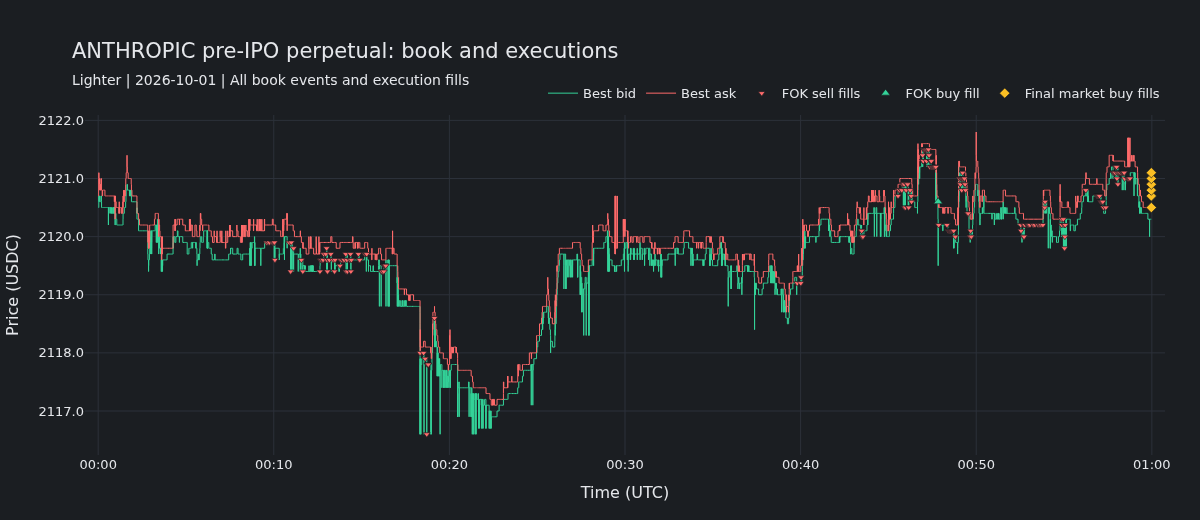
Figure 1. The FOK sells build the short position. One FOK buy reduces it, and the final market buy closes it through six fills at the same simulated timestamp. The closing fills can execute above the best ask because the order consumes several price levels. Sharp quote spikes include intermediate states lasting microseconds between recorded level updates. This zero-latency strategy can fill at these prices.
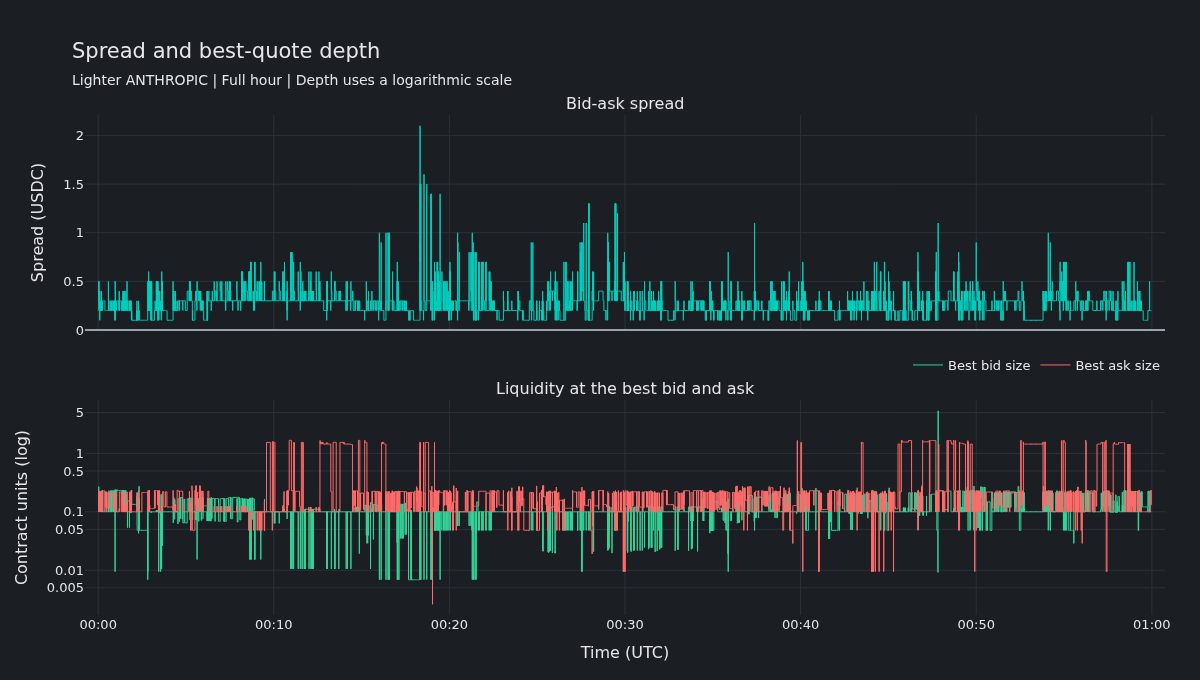
Figure 2. Across all states, the spread is in [0.1, 2.1] USDC.
For states lasting at least one millisecond, it is in [0.1, 0.9] USDC.
Durations use receipt time until the next recorded update: 7,342 of
14,813 measured intervals are shorter than 10 microseconds. Best-quote
sizes vary across several orders of magnitude, so depth uses a
logarithmic axis. Sizes are contract units, not company shares.
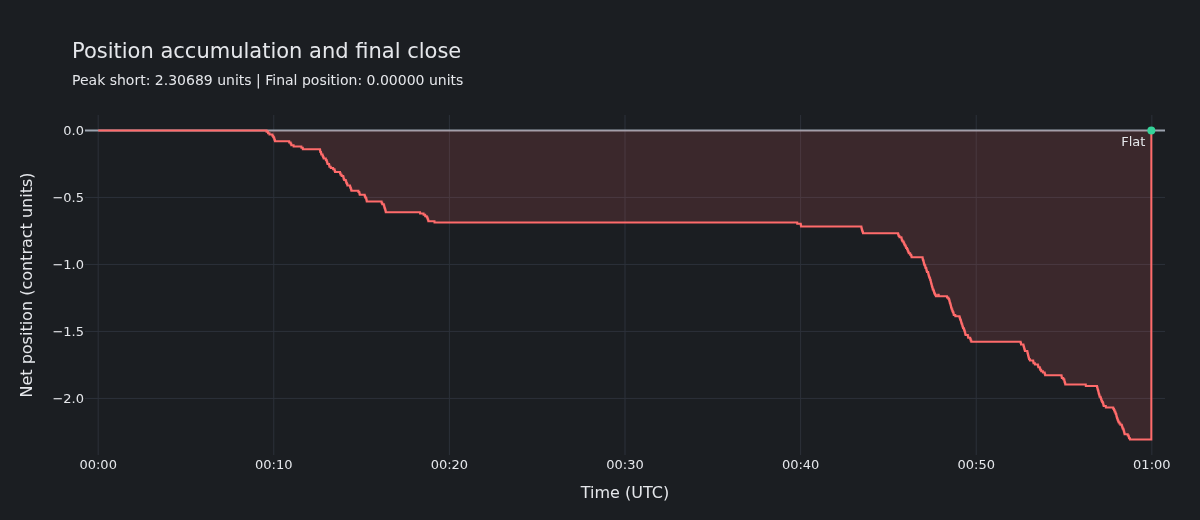
Figure 3. Cumulative signed execution quantities show the short reaching 2.30689 units. The final market order returns exposure to zero.
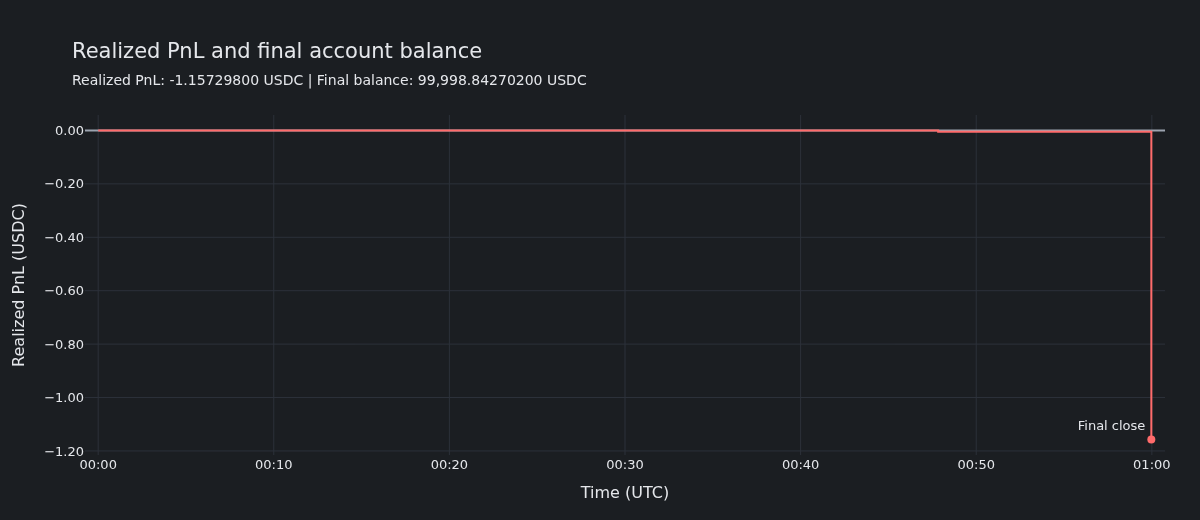
Figure 4. The account's total balance change gives realized PnL for this zero-fee run. The final drop books the loss accumulated while holding the short, plus the cost of consuming several ask levels to close. Unrealized PnL during the holding period is omitted.
Regenerate the panels
Panel generation uses Plotly and Kaleido. Kaleido also requires a Chrome-compatible browser. From a source checkout, run:
uv run --project python --no-sync --with pandas --with plotly --with kaleido \
    python docs/tutorials/assets/backtest_orderbook_coinapi/render_panels.py
If Kaleido reports that Chrome is missing, install its browser once with:
uv run --project python --no-sync --with plotly --with kaleido plotly_get_chrome -yThe renderer runs this tutorial and writes PNGs to
docs/tutorials/assets/backtest_orderbook_coinapi/. It reuses the cached
export or follows the first-download procedure above.
To test another hour, list its available objects and select the ANTHROPIC file
using CoinAPI's
S3 SDK guide.
Update OBJECT_KEY and FILE_SHA256 together after verifying the new file.
Check the file schema, opening snapshot, and instrument precision before
loading it. The CoinAPI integration guide
describes the accepted CSV layout and timestamp rules.
Backtest with Order Book Depth Data (Bybit)
Replay Bybit ob500 order book deltas through BacktestNode and run the OrderBookImbalance strategy. Same shape as the Binance variant, different loader and...
Backtest with Polymarket Order Book Data (FinFeed)
Retrieve historical Polymarket L2 order book data through FinFeed, cache it in a Parquet catalog, and run an order book imbalance backtest. This example...